


 support@brosisco.store
Last Updated: October 25, 2026
Quick Summary
To measure ring size at home, wrap string or dental floss around the base of your finger, mark where it overlaps, then measure that length against a ruler in millimeters and convert it to a ring size using a chart. Alternatively, measure the inner diameter of a ring that fits comfortably, or use paper or a phone measuring app for similar accuracy.
- Measure twice on two different days at different times to confirm consistency before ordering.
- Use unwaxed dental floss or thin, non-stretchy string for the most accurate string method results.
- For wide bands 3 mm or wider, size up by half a size since they sit higher and feel tighter than thin bands.
- If your knuckle is noticeably wider than your finger base, size the ring to clear your knuckle rather than fit snugly at the base.
- Avoid measuring right after exercise, in extreme temperatures, or after salty meals when fingers are swollen.
Table of Contents
- Why Accurate Ring Sizing Matters Before You Order
- How to Measure Ring Size with String or Dental Floss
- Measuring with Paper: A Quick Alternative Method
- How to Measure Ring Size with a Ring You Already Own
- Using a Ring Size Chart to Convert Your Measurements
- How to Measure Ring Size with Your Phone
- Factors That Affect Your Ring Size and How to Account for Them
- Order Your Perfect Ring with Confidence
- Frequently Asked Questions
Why Accurate Ring Sizing Matters Before You Order
Getting the right ring size seems simple but makes all the difference. A ring that's too loose slides off; one that's too tight cuts off circulation and feels uncomfortable all day.
The good news: measuring your ring size at home is straightforward. You don't need expensive tools or a jeweler's appointment. With materials you probably have in your kitchen right now, you can find your accurate ring size in minutes.
At BroSisCo, we help customers find the perfect personalized gifts, including jewelry that needs to fit just right. Getting sizing correct before you order means your gift arrives ready to wear.
How to Measure Ring Size with String or Dental Floss
The string method is the most accessible way to measure ring size at home. Wrap string around your finger, mark where it overlaps, then measure that length against a ruler, this gives you the inner circumference, which converts directly to a ring size.
Here's how to do it:
-
Gather your materials. You'll need string or dental floss (unwaxed floss works best), a ruler or measuring tape, and a pen or marker.
-
Wrap around your finger. Wrap the string around the base of the finger where you want to wear the ring, most rings sit just above where your hand widens, not high on the knuckle.
-
Mark the overlap point. Where the string overlaps itself, make a small mark with your pen to show where the full loop ends.
-
Measure the length. Lay the string flat on a ruler or measuring tape. Measure from the end of the string to your mark. Write down this measurement in millimeters.
-
Convert to ring size. Use a ring size chart to match your measurement to the corresponding size.
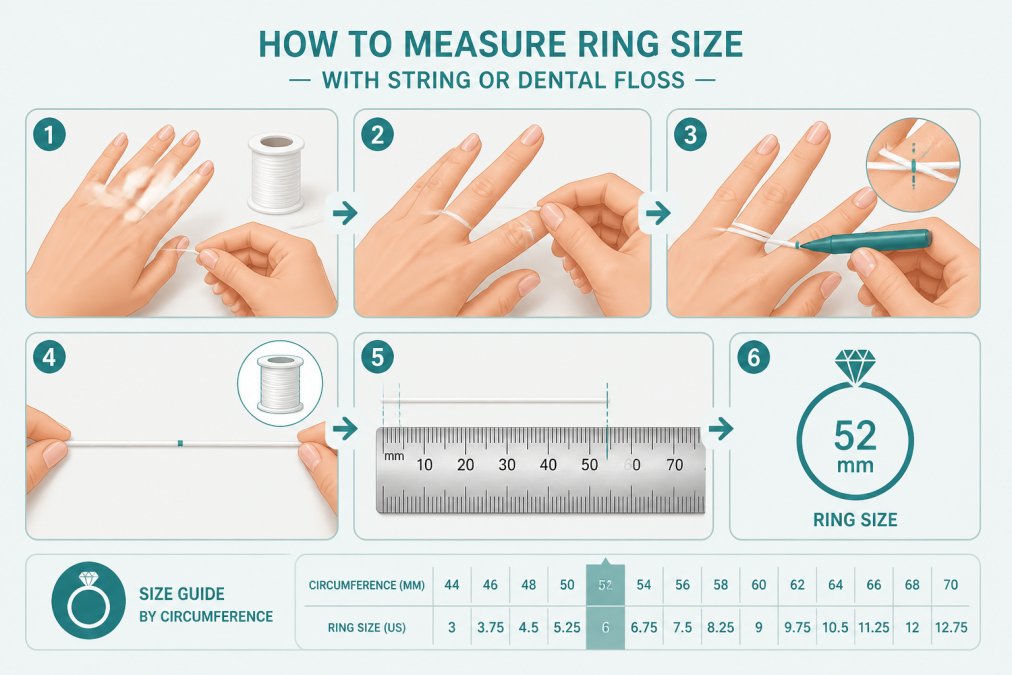
Watch out: If your string is stretchy or the floss frays, your measurement will be inaccurate. Use a thin, non-stretchy string for the best result.
Measuring with Paper: A Quick Alternative Method
If you don't have string handy, a strip of paper works just as well, it's easy to mark and measure, nearly as accurate as the string method, and takes about the same time.
Follow these steps:
-
Cut a thin strip of paper. Use regular printer paper or notebook paper. The strip should be about half an inch wide and long enough to wrap around your finger.
-
Wrap the paper around your finger. Wrap it around the base of your finger where the ring will sit, keeping it flat against your skin so it doesn't twist or bunch up.
-
Mark where the paper overlaps. Use a pen to mark the exact point where the end of the paper meets the beginning.
-
Lay flat and measure. Place the paper strip on a ruler. Measure from the end to your mark in millimeters.
-
Check your measurement twice. Repeat the process on the same finger to confirm consistency. If the two measurements differ by more than 1 mm, repeat until you get matching results.
The paper method works best if your paper is crisp and unwrinkled. Crumpled paper will give you a false measurement.
How to Measure Ring Size with a Ring You Already Own
If you already have a ring that fits comfortably, you can measure it directly. This is often the most accurate method because you're measuring an object rather than relying on how tightly you wrap something around your finger.
Here's the process:
-
Choose a ring that fits well. Pick a ring you wear regularly on the same finger where the new ring will go, snug but not tight, comfortable enough to wear all day.
-
Measure the inner diameter. Place the ring on a ruler. Measure the distance straight across the inside of the ring from one edge to the opposite edge. This is the inner diameter.
-
Write down the measurement. Record this measurement in millimeters.
-
Use a ring size chart. Match your diameter measurement to a ring size chart. The chart converts diameter measurements to standard ring sizes.
-
Order with confidence. If the ring you measured is comfortable, a new ring with the same size will fit the same way.
This method skips the guesswork of wrapping and marking, you're measuring a finished product you know fits well. When you order a personalized ring from BroSisCo with this measurement, it will arrive ready to wear.
Using a Ring Size Chart to Convert Your Measurements
A ring size chart is the bridge between your measurement and the size you need to order.
Most charts use this format:
| Ring Size | Inner Circumference (mm) | Inner Diameter (mm) |
|---|---|---|
| 4 | 46.5-47 | 14.9 |
| 4.5 | 47.5-48 | 15.3 |
| 5 | 49-50 | 15.7-16 |
| 5.5 | 50.5-51 | 16.1 |
| 6 | 52-53 | 16.5-17 |
| 6.5 | 53.5-54 | 17.1 |
| 7 | 55-57 | 17.4-18.2 |
| 7.5 | 57.5-58 | 18.3 |
| 8 | 58-59 | 18.5-18.8 |
| 8.5 | 59.5-60 | 18.9 |
| 9 | 61-62 | 19.4-19.8 |
| 9.5 | 62.5-63 | 19.9 |
| 10 | 64-65 | 20.3-20.7 |
| 10.5 | 65.5-66 | 20.8 |
| 11 | 67-68 | 21.2-21.6 |
| 12 | 69-70 | 21.9-22.2 |
| 13 | 71-72 | 22.6-23.0 |
Handle borderline measurements deliberately. If your circumference falls between two sizes, round up, a slightly loose ring is more comfortable than a tight one. For a band 3 mm or wider, rounding up matters even more because the wider surface sits higher on the finger and feels tighter. Between sizes on a wide band, go with the larger size.
Don't trust a chart you can't verify. Charts vary slightly between sources, and one copied from an unverified page can be off by half a size.
Avoid false precision. A measurement taken with stretchy string or a worn ruler can look precise to the millimeter while being off by a full size.
Keep your measurement, the chart you used, and the date you measured together when you order.
How to Measure Ring Size with Your Phone
Your smartphone can help you measure ring size if you don't have a ruler handy. Many phones include a built-in measuring app, or you can download one, the camera and app work together to estimate distances between objects.
Here's how to use this method:
-
Download a measuring app. Search your app store for "measure" or "ruler." Most phones have a built-in Measure app (iPhone) or Google Measure (Android).
-
Place your ring on a flat surface. Set the ring on a table or counter where your phone can see it clearly from above.
-
Use the app to measure the inner diameter. Open the app and follow its instructions to measure across the inside of the ring from edge to edge. The app uses your phone's camera to estimate the distance.
-
Take multiple measurements. Measure at least twice to confirm accuracy, phone-based measurements vary with angle and lighting.
-
Convert to ring size. Use the diameter measurement with a ring size chart to find your size.
Phone measuring apps work best in good lighting with the phone held steady. If your measurements seem off, fall back on the string or paper method for verification.
Factors That Affect Your Ring Size and How to Account for Them
Your finger size isn't constant, it changes throughout the day with temperature, activity, and even what you ate.
Temperature and time of day. Fingers swell in warmth and shrink in cold because blood vessels near the skin dilate and constrict. They're smallest first thing in the morning and largest in the late afternoon or after activity (The identification of diurnal variations on circulating immune cells by finger prick...).
Activity and salt. Exercise, hot weather, and salty meals promote fluid retention that shows up in your fingers.
Knuckle-dominated fingers. Some people have a knuckle noticeably wider than the base of the finger. Measure both the circumference at the base where the ring will rest and over the knuckle.
Repeatability is the real test. Measure on at least two different days at different times and compare. Consistent results within half a millimeter mean you can order with confidence; results that spread across a full size or more mean your finger fluctuates significantly, size for the larger measurement and consider a thinner band, which tolerates fluctuation better.
Sizing a ring as a surprise. If you're measuring for someone else, don't guess from a photo.
Order Your Perfect Ring with Confidence
You now have the tools to measure your ring size accurately at home. Whether you use string, paper, an existing ring, or your phone, the process takes a few minutes and costs nothing.
When you're ready to order a personalized ring or gift from BroSisCo, use the size you've measured. Our 100% customer satisfaction guarantee means if the ring doesn't fit as expected, we'll work with you to make it right.
Take your measurement today, double-check it tomorrow, and order the ring you've been looking for. Getting the size right is the first step to a gift that fits perfectly and feels made just for them.
Frequently Asked Questions
How do I measure my ring size at home accurately?
The most reliable method is to measure ring size with string or dental floss wrapped snugly around your finger at the base, then mark where it overlaps and measure that length against a ruler in millimeters. Convert the measurement using a standard ring size chart. For best results, measure multiple times throughout the day, morning measurements tend to be smaller than evening ones, and repeat on different days to account for natural finger swelling from activity and temperature changes.
Can I use string or paper to measure my ring size?
Yes, both work well. String and dental floss conform closely to your finger's shape, making them ideal for accurate measurements. Paper strips are also effective and easier to mark. Wrap your chosen material snugly around the base of your finger where the ring will sit, mark the overlap point, then measure the marked length against a ruler. The key is ensuring a comfortable, snug fit, not too tight, not too loose.
What if I'm between ring sizes?
If your measurement falls between two sizes, consider the ring's width. Wider bands typically feel tighter, so size up for comfort. Narrow bands may feel looser, so you can size down or stay with the smaller size. Also account for your typical finger swelling: if your fingers swell during warm weather or after activity, size up. When ordering personalized jewelry as a gift where you're unsure, sizing up is generally the safer choice.
How does temperature and time of day affect my ring size?
Fingers naturally swell in warm temperatures and shrink in cold conditions due to blood vessel expansion and contraction. Time of day also matters: fingers are smaller in the morning and swell throughout the day, especially after activity or meals. For the most accurate measure ring size, take measurements in the afternoon or evening under normal conditions, and repeat over several days. This accounts for natural daily variation and helps you find a size that fits comfortably across different times and seasons.
American Gem Society ring sizing standards
Jewelry industry standard sizing guides
Consumer guidance on ring sizing accuracy


