


 support@brosisco.store
Last Updated: October 24, 2026
Quick Summary
To identify sterling silver jewelry, look for a hallmark stamp showing 925 or higher purity, use simple at-home tests like the magnet and ice tests, and inspect the construction for solid weight and smooth joints. Real sterling silver is 92.5% pure silver and built to last, while silver-plated pieces have only a thin surface layer over base metal.
- The 925 hallmark indicates 92.5% pure silver, the standard purity recognized worldwide for genuine sterling silver.
- Silver-plated jewelry has only a thin layer of silver over base metal and wears away quickly, unlike solid sterling silver.
- Home tests like the magnet test, ice test, and weight test help verify authenticity but should be used together, not alone.
- Quality construction includes smooth solder lines, secure stone settings, substantial weight, and smooth-closing clasps.
- Expensive or sentimental pieces should be verified by a professional jeweler or assay service rather than home tests alone.
Table of Contents
- What Sterling Silver Is and Why Purity Matters
- How to Tell If Silver Is Real: Reading Hallmarks and Stamps
- Understanding 925 Sterling Silver Meaning and Other Purity Marks
- Sterling Silver vs Silver Plated: What's the Real Difference
- How to Test Sterling Silver at Home: Safe, Effective Methods
- Evaluating Construction Quality and Workmanship
- Choosing High Quality Sterling Silver Jewelry You'll Love
- Frequently Asked Questions
What Sterling Silver Is and Why Purity Matters
Sterling silver is an alloy of 92.5% pure silver and 7.5% other metals, typically copper, the standard purity recognized worldwide. Pure silver is too soft for jewelry, so the copper adds strength while keeping the silver content high enough to call it genuine.
When you identify sterling silver jewelry, you're checking two things: whether the piece contains that 92.5% silver content, and whether the craftsmanship justifies the price. A ring stamped 925 might be real sterling, but a weak setting or paper-thin band won't last.
At BroSisCo, we offer a curated selection of personalized jewelry that's both authentic and built to last.
How to Tell If Silver Is Real: Reading Hallmarks and Stamps
Purity marks state the silver content, usually as a three-digit number. Maker's marks identify the manufacturer. Assay marks are independent verification stamps. Plating marks indicate a silver layer over a base metal.
Common purity marks you'll see:
- 925, The most common mark. It means 92.5% pure silver.
- 999, Fine silver, which is 99.9% pure. Rare in jewelry because it's too soft.
- 958, Britannia silver, 95.8% pure. Stronger than fine silver but softer than sterling.
- 950, 95% pure. Common in some European and Asian jewelry traditions.
- 900, 90% pure. Found in coin silver and some older or imported pieces.
- 835, 83.5% pure. A common European standard, lower than sterling.
- 800, 80% pure. Legal to sell but lower quality than 925.
How to tell a purity mark from a maker's mark. Purity marks are almost always numeric and standardized; maker's marks are letters, symbols, or a name, often inside a small shaped outline.
How to spot plating marks. Words like "plated," "vermeil," "gold-filled," "EP," "EPNS," "silver-filled," or "silver on copper" mean the silver is a surface layer, not the body of the piece.
International and nonstandard marks. Jewelry made outside the United States often carries marks that don't look like the 925 you're used to. Common patterns include:
- A numeric purity mark combined with a city or assay office symbol, common on older European pieces.
- A national assay mark, such as a small emblem stamped by a government assay office after testing.
- Import marks applied when a piece entered a country, which may sit alongside the original maker's mark.
- Date letters, which are letter codes used by some assay systems to indicate the year of assay.
These marks aren't a substitute for a 925 stamp, but they are evidence a piece was tested and registered.
What a good stamp looks like. The hallmark should be clear and sharp, not blurry or worn. A worn stamp might mean the piece is old or heavily used; a blurry or fake-looking stamp is a red flag.
Not all silver jewelry carries a hallmark, especially vintage pieces or items made outside the United States. If there's no stamp, test the piece using other methods; if the stamp is ambiguous, a jeweler or assay service can interpret it before you buy.
Common purity marks indicate the silver content and help you identify genuine sterling silver.
| Mark | Purity | Notes |
|---|---|---|
| 925 | 92.5% pure silver | Most common mark, standard worldwide |
| 999 | 99.9% pure silver | Fine silver, too soft for most jewelry |
| 958 | 95.8% pure silver | Britannia silver, stronger than fine silver |
| 950 | 95% pure silver | Common in European and Asian jewelry |
| 900 | 90% pure silver | Found in coin silver and older pieces |
| 835 | 83.5% pure silver | Common European standard, lower quality |
| 800 | 80% pure silver | Legal to sell but lower quality than 925 |
Understanding 925 Sterling Silver Meaning and Other Purity Marks
925 sterling silver means the piece is 92.5% pure silver by weight. The remaining 7.5% is usually copper, which strengthens the metal and improves durability. This ratio has been the standard for centuries, and without the copper, pure silver would scratch, dent, and bend under normal wear.
Other purity marks tell a different story:
- 999 fine silver is almost pure, but too soft for everyday rings or bracelets. It's better for investment pieces or decorative items.
- 800 silver is lower quality. It contains only 80% silver and tarnishes faster than 925.
- 950 silver sits between 925 and 999. It's stronger than fine silver but still soft compared to 925.
For daily wear, 925 is the sweet spot: strong enough for regular use, pure enough to be called genuine silver. Anything lower than 925 is technically silver-plated or a lower-grade alloy, not true sterling silver.
Sterling Silver vs Silver Plated: What's the Real Difference
Sterling silver and silver-plated jewelry look identical at first glance, but they're fundamentally different, and the difference matters for durability and long-term value. Explore a comprehensive guide to choosing between silver and gold jewelry options to help you decide which metal suits your needs best.
Sterling silver is solid throughout. The band, setting, and clasp are all 92.5% silver. Scratch a sterling silver ring and you see silver underneath; wear it for decades and it still contains that silver core.
Silver-plated jewelry has a thin layer of silver bonded to a base metal underneath, usually brass or copper, often only a few microns thick.
For gifts and heirloom pieces, sterling silver wins every time: it lasts, polishes up, and can be passed down. Silver-plated jewelry is cheaper upfront but not built to last. For personalized jewelry from BroSisCo, we focus on sterling silver because it deserves the personal meaning you're investing in.
Here's the practical test: check the hallmark. Sterling silver says 925, 950, or 999. Silver-plated items say "plated," "vermeil," "EP," or "EPNS."
How to Test Sterling Silver at Home: Safe, Effective Methods
You don't need a jeweler to verify sterling silver, several simple tests work at home and cost almost nothing.
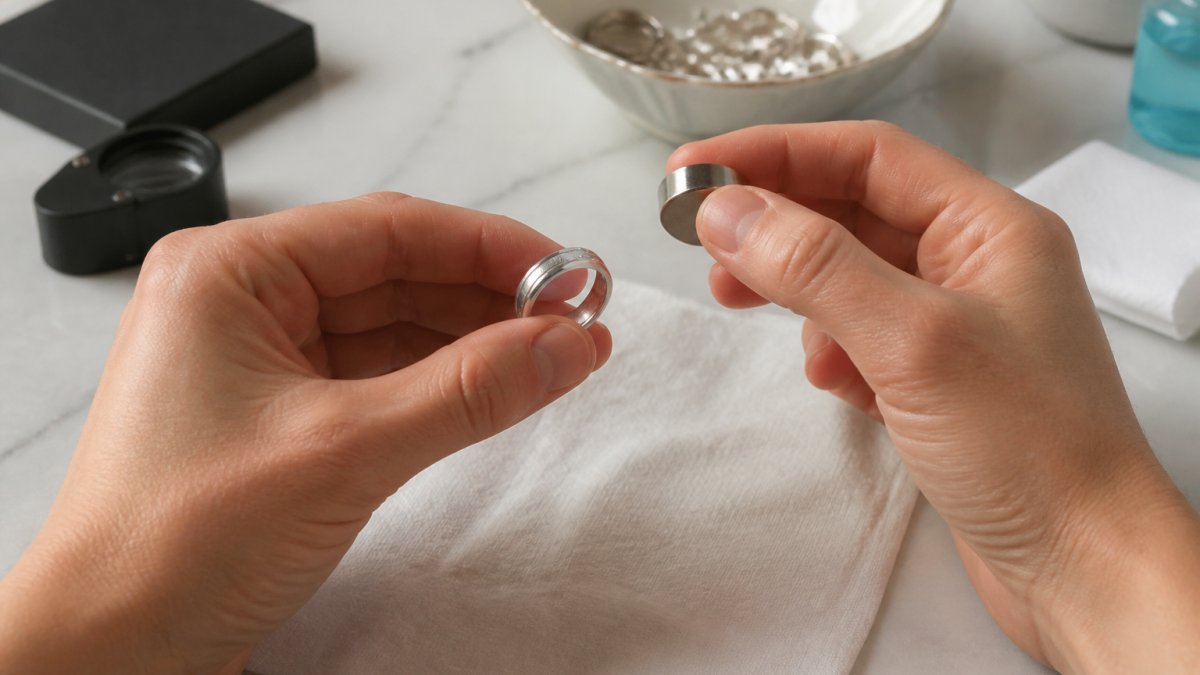
The Magnet Test
Silver is not magnetic. If a strong magnet sticks to a piece, it contains ferrous metals, iron or steel, and is not pure silver.
Limitation: Some alloy metals are also non-magnetic, so this test only rules out certain fakes.
The Ice Test
Silver conducts heat extremely well, so real silver feels cold and warms slowly in your hand.
Limitation: Some base metals conduct heat reasonably well, so this test isn't foolproof. It also says nothing about whether the silver is solid or plated.
The Weight Test
Silver is dense, so a real sterling silver ring or bracelet should feel substantial.
The Sound Test
Drop a real silver coin or piece onto a hard surface: it makes a clear, ringing tone, while fake or plated pieces thud dully.
The Acid Test (Professional Method)
Jewelers use nitric acid: a tiny drop produces a specific color reaction indicating purity.
The Scratch Test (Use With Caution)
When to stop testing and get professional verification. If the piece is expensive, has sentimental value, carries an ambiguous hallmark, or comes with claims you can't verify, take it to a jeweler or assay service. Ask what method was used, whether the test was surface-only or through the piece, and whether the result is documented in writing. If you suspect misrepresentation, keep the listing, receipt, and written claims, and contact your state attorney general's consumer protection office or the Federal Trade Commission.
Evaluating Construction Quality and Workmanship
A sterling silver hallmark tells you the metal is real. It doesn't tell you whether the piece is built to last. Quality construction separates jewelry you'll wear for decades from pieces that fall apart in months.
Look at the joints and seams: solder lines should be smooth and invisible, and rough, lumpy solder signals poor workmanship. Check the setting, a loose stone or uneven prongs mean the piece wasn't made carefully. Feel the weight and thickness: a quality sterling silver ring should feel substantial, since thin, hollow bands bend and break. Examine the clasp, it should click or close smoothly without gaps.
At BroSisCo, we prioritize craftsmanship because personalized pieces carry meaning, they need to survive daily wear and look beautiful for years. Check for rough edges or burrs that snag clothing; quality pieces are finished completely before they ship. And ask about the maker: small makers who stand behind their work often do better finishing than mass-produced items.
Choosing High Quality Sterling Silver Jewelry You'll Love
Once you know how to identify real sterling silver, the next step is choosing pieces built well enough to keep. Start with the hallmark, 925 or higher, and skip anything marked as plated or lower-grade alloy. Inspect the construction: hold it up to light and look for smooth joints, solid weight, and clean finishing, if it feels fragile or looks rushed, it probably is. Consider the maker's reputation: do they offer a guarantee, and can you contact them with questions?
For personalized jewelry, check out our curated selection of sterling silver necklaces and bracelets designed for daily wear and built to last. Each piece is assembled and shipped from the USA, with our 100% customer satisfaction guarantee backing every purchase. When you're investing in something personal and meaningful, you deserve quality that matches.
Identifying high quality sterling silver jewelry comes down to three steps: verify the hallmark, test authenticity with simple at-home methods, and evaluate the construction carefully. Real sterling silver carries the 925 mark, feels substantial in your hand, and shows skilled craftsmanship in every joint and seam. When you find a piece that passes all three checks, you've found something worth wearing, and worth keeping. Learn more about how personalized jewelry holds up for daily wear, and discover why sterling silver is the choice for gifts meant to last.
Frequently Asked Questions
What does the 925 stamp mean on silver jewelry?
The 925 stamp indicates that the piece contains 92.5% pure silver and 7.5% other metals, typically copper. This ratio defines sterling silver, the standard for fine jewelry. The remaining 7.5% strengthens the silver, which is too soft on its own for durable jewelry. Any piece marked 925 meets the official purity standard for sterling silver jewelry.
How can you tell sterling silver from silver-plated jewelry?
Sterling silver jewelry has a hallmark (925, 950, or 999) stamped inside or on the piece. Silver-plated items rarely carry such marks and feel lighter. Magnet tests and weight comparisons help: genuine sterling silver is heavier and shows consistent tarnish patterns over time. Silver plating wears away with use, exposing a different metal underneath, while sterling silver maintains its composition throughout.
Are all 925 sterling silver pieces the same quality?
No. While all 925-marked pieces contain the same silver content, quality varies based on construction, design, and workmanship. Inspect joints, clasps, and seams for smooth finishing. Check that solder lines are clean and settings hold stones securely. Thicker gauge wire and solid construction indicate higher quality. A reputable maker's reputation and attention to detail matter as much as the purity mark.
What are the easiest ways to test silver jewelry at home?
The magnet test is simplest: genuine sterling silver is not magnetic, so it won't stick to a strong magnet. The ice test uses silver's thermal conductivity, place ice on the piece and it should melt quickly due to heat transfer. The weight test compares a suspected piece to a known sterling silver item of similar size; authentic pieces feel noticeably heavier. These tests have limitations and false positives, so combine multiple methods for confidence.


