


 support@brosisco.store
Table of Contents
- Quick Comparison: Silver vs Gold Personalized Jewelry
- Price and Budget: What Each Metal Actually Costs
- How to Determine Skin Undertone for Jewelry Gifts
- Durability of Sterling Silver vs Gold Plated Jewelry
- Caring for Personalized Silver Jewelry and Gold Pieces
- Personalization Techniques That Work Best for Each Metal
- Which Metal Makes the Better Gift? A Decision Framework
- Conclusion
- Frequently Asked Questions
Last Updated: September 20, 2026
Quick Comparison: Silver vs Gold Personalized Jewelry
Choosing between personalized silver jewelry vs gold jewelry for gifts comes down to three things: budget, skin undertone, and how the piece will be worn. Silver-tone pieces offer a lower entry price and a cool, modern look, while gold-tone pieces carry warmth and a more traditional feel.
Price and Budget: What Each Metal Actually Costs
- Silver-tone base metals (stainless steel, brass with a silver finish): The lowest entry point. The personalization cost is identical to any other finish, so this is where you get the most design for the least money.
- Sterling silver (.925): A solid precious-metal alloy. Priced above base metals but far below gold, and it carries real material value because the silver runs all the way through.
- Gold plated / gold finished: A thin layer of gold over a base metal. The look reads premium, but you're paying for appearance, not gold content.
- Gold filled: A thicker, bonded layer of gold (legally required to be at least 5% of the piece's total weight by FTC standards). More durable than plating, priced between plated and solid.
- Solid gold (10K, 14K, 18K): The top of the ladder. The gold is the piece, so the price tracks the daily spot price of gold plus fabrication. This is where a name necklace can jump from double digits into the hundreds or thousands.
A few budget realities to keep in mind:
- Personalization is usually a flat fee, not a metal-dependent one. Engraving, character limits, and symbol accents cost the same whether the base is silver-tone or gold-tone, so the metal is the only lever you're pulling.
- Silver-tone and stainless options stretch a gift budget further, so you can add a second small gift or upgrade the packaging.
- Gold-tone finishes read as more premium, which can matter for milestone occasions where presentation carries weight.
- Solid gold costs significantly more than plated or filled pieces, but that price reflects recoverable material value, plated pieces have almost none.
- Shipping thresholds tip the total. BroSisCo's free shipping kicks in at $70, so a single $55.65 piece lands just under the line. Adding a second item or a box upgrade can push you over and effectively erase the shipping cost.
One more budget angle most guides skip: resale and trade-in value. Sterling silver and solid gold hold recoverable material value; plated and gold-finished pieces do not. For a milestone gift that should retain worth, sterling silver is the quiet value play, a fraction of solid gold's cost with intrinsic metal value if the recipient ever wants to trade or reset it.
How to Determine Skin Undertone for Jewelry Gifts
Determining skin undertone for jewelry is the fastest way to pick a metal that flatters. Undertone is the subtle hue beneath the skin, falling into three camps: cool, warm, and neutral.
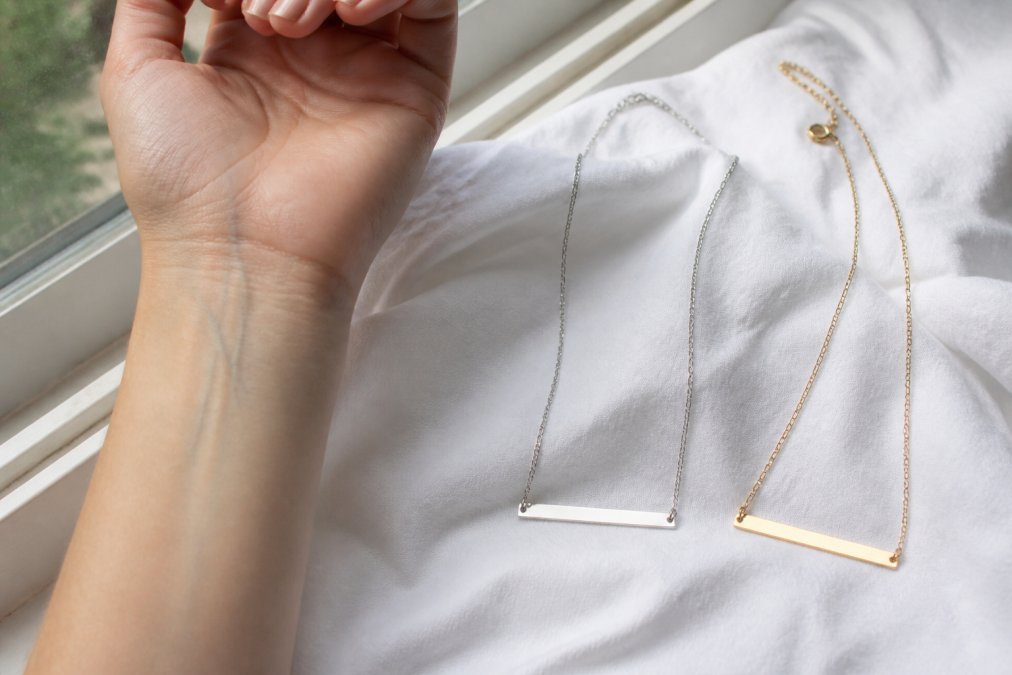
You don't need a lab, just three quick checks.
- The vein test: Look at the veins on the inside of the wrist in natural light. Blue or purple veins point to cool undertones. Green veins point to warm. A mix suggests neutral.
- The jewelry test: Hold a silver-tone piece next to the skin, then a gold-tone piece. Whichever makes the skin look brighter and more even is usually the match.
- The white paper test: In daylight, hold a plain white sheet near the face. If the skin looks pink or rosy against it, that leans cool. If it looks golden or peachy, that leans warm.
Durability of Sterling Silver vs Gold Plated Jewelry
Durability of sterling silver vs gold plated jewelry depends on what's underneath the finish. Sterling silver is a solid alloy, so wear shows as a soft patina rather than a worn-through coating. Gold plated jewelry has a thin gold layer over base metal that can thin with friction and moisture.
- Sterling silver: Solid throughout. It can scratch and tarnish, but it can also be polished back to a shine.
- Gold plated: The look is warm and rich, but the plating can wear at high-contact points like clasps and chain links.
- Stainless steel with a gold finish: A durable base with a warm look, common in everyday personalized pieces.
- Solid gold: The most durable option, and the most expensive, because the gold runs all the way through.
Caring for Personalized Silver Jewelry and Gold Pieces
Caring for personalized silver jewelry and gold pieces comes down to three habits: keep them dry, keep them separate, and clean them gently. Most damage is slow, caused by moisture, perfume, and pieces rubbing together in a drawer.
A simple care routine:
- Put jewelry on last, after lotion and perfume have dried.
- Take pieces off before showering, swimming, or washing dishes.
- Store each piece in its own pouch or the box it arrived in.
- Wipe silver with a soft cloth to slow tarnish.
- Clean gold-tone finishes with mild soap and water, then dry fully.
Personalization Techniques That Work Best for Each Metal
How each finish handles wear over time:
- Sterling silver engraving: The cut is in solid metal, so it doesn't wear away. Tarnish can fill the grooves over years, actually increasing contrast, a quick polish restores the bright field while leaving the recessed lines dark.
- Gold plated engraving: The cut goes through the plating into the base metal. Over time, the exposed base metal can darken differently than the surrounding gold, making letters look muddy rather than crisp, the biggest long-term risk with engraved plated pieces.
- Solid gold engraving: Like sterling silver, the cut is in solid metal and holds its shape indefinitely. It won't discolor, but it also won't develop the high-contrast patina that silver does, the engraving stays subtle.
- Stainless steel with a gold finish: The base is hard and corrosion-resistant, so the engraving holds up better than plated brass, but the same contrast-loss risk applies at the cut edges.
Techniques that hold up best by finish:
- Cursive name engraving: Works on both finishes, suiting gold-tone warmth and silver-tone minimalism equally. On silver, the flowing lines develop beautiful contrast as patina settles in.
- Block or serif lettering: Reads more crisply on silver and stainless because the straight cuts catch sharper shadow. On gold-tone, block lettering can look flat.
- Symbol accents: A heart or paw print pairs well with a name in either finish. Symbols with fine interior detail (like a paw pad) hold definition better on solid metals than on plated ones.
- Vertical and stacked layouts: A stacked name design adds visual interest and works in both metals, but vertical layouts put more engraving surface in contact with skin and clothing, so plated versions wear faster at the edges.
- Character limits: Most personalized name pieces cap at around 10 characters, so shorter names and nicknames fit best. Longer names force smaller lettering, and smaller lettering on plated metal is the first thing to lose definition.
Which Metal Makes the Better Gift? A Decision Framework
The better gift is the one matched to the recipient, not the one with the higher price tag. Use this framework to decide fast.
| If the recipient... | Choose | Why |
|---|---|---|
| Has cool undertones | Silver-tone | Cool tones flatter silver and white gold |
| Has warm undertones | Gold-tone | Warm tones glow with yellow and rose gold |
| Wears jewelry daily | Stainless or solid | Holds up to constant wear |
| Wears it for occasions | Either finish | Plating lasts with light use |
| Prefers modern, minimal style | Silver-tone | Reads clean and contemporary |
| Prefers classic, traditional style | Gold-tone | Feels warm and timeless |
| Is budget-conscious | Silver-tone or stainless | Lower cost, same personalization |
| Wants a milestone keepsake | Gold-tone or solid | Carries a premium feel |
Conclusion
The hardest part of choosing between personalized silver jewelry vs gold jewelry for gifts isn't the metal. It's matching it to a real person, their undertone, habits, and the moment you're celebrating. That's what makes a gift feel considered instead of generic.
Frequently Asked Questions
Does skin tone really affect whether silver or gold jewelry is a better gift?
Yes. The vein test is the simplest way to check: look at the veins on the inside of the wrist. Blue or purple veins usually mean cool undertones, which pair well with silver and white metals. Green veins suggest warm undertones, which flatter yellow gold. If veins look like a mix, neutral undertones work with either metal. This matters for gifts because a piece that complements the recipient's undertones gets worn far more often.
How durable is sterling silver compared to gold plated jewelry for everyday wear?
Sterling silver is a solid metal alloy, so scratches and dents can be polished out, and it holds up for years with regular care. Gold plated jewelry has a thin layer of gold over a base metal, and that plating can wear away over time, especially with daily wear, exposure to water, or contact with lotions. For a gift meant to be worn every day, sterling silver or a solid gold piece lasts longer than plated options.
How do I care for personalized silver jewelry so it stays looking new?
Store silver pieces in an airtight bag or the original box to slow tarnish. Remove jewelry before showering, swimming, or applying lotion. Wipe it with a soft polishing cloth after each wear. If tarnish builds up, a gentle silver polishing cloth or a quick dip in a silver cleaner restores shine. Engraved or name-cut areas collect residue, so a soft-bristle brush helps clean those details without scratching the surface.
What is the 2:1:1 rule for jewelry, and does it apply to personalized gifts?
The 2:1:1 rule is a styling guideline: wear two of one metal, one of a second metal, and one accent piece. It keeps mixed-metal looks balanced rather than chaotic. For personalized gifts, this means a silver name necklace pairs well with silver earrings and a single gold accent ring. If the recipient already wears mostly one metal, a personalized piece in that same metal gets the most wear.
Is silver or gold jewelry more popular for gifts right now?
Both remain strong, but preferences shift by age and style. Younger gift recipients often lean toward silver or stainless steel for everyday, casual looks. Gold tones carry a traditional, luxury feel that many people associate with milestone gifts like anniversaries or 70th birthdays. The safest approach is to match the metal to what the recipient already wears, since personal style beats trends for a gift they will actually use.


